50 Museum Flat Round Icons: A Visual Toolkit for Modern Storytelling
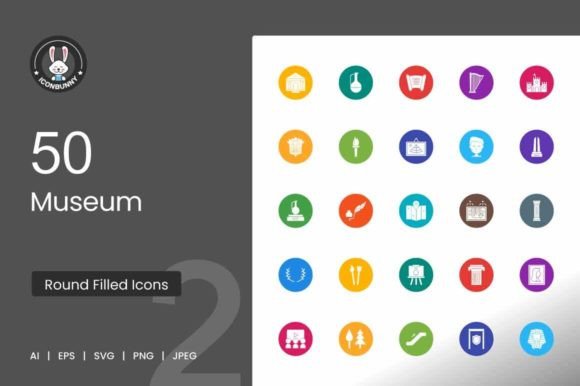
In the digital age, where attention spans are fleeting and visual communication is paramount, the ability to convey complex ideas instantly is a superpower. This is where iconography becomes more than just decoration; it becomes a fundamental language of user experience. The 50 Museum Flat Round Icons collection represents a strategic response to this need, offering a curated set of visual assets designed to bridge the gap between historical depth and modern interface design. Whether you are building a mobile app for an art gallery, designing a website for a heritage site, or creating educational templates, these icons provide the clarity and aesthetic consistency that contemporary audiences expect.
The Evolution of Cultural Iconography in Digital Spaces
Historically, representing museums and cultural artifacts in digital media was often clunky. Designers relied on generic stock photography or low-resolution clip art that failed to capture the nuance of the subject matter. As web and mobile technologies have advanced, user expectations have shifted dramatically. Today's users demand interfaces that are clean, intuitive, and visually cohesive. The trend has moved away from skeuomorphism—designs that mimic real-world textures—toward flat design principles that prioritize scalability and readability.
This shift explains why collections like the 50 Museum Flat Round Icons have gained traction. The "flat round" style is not merely an aesthetic choice; it is a functional one. Rounded shapes are psychologically perceived as friendlier and more approachable than sharp angles, making them ideal for guiding users through complex information architectures. When applied to museum content, which can sometimes feel intimidating or overly academic, these soft, circular icons help democratize access to culture. They signal that the content within is accessible, organized, and ready to be explored.
Bridging History and Modern Workflow
The relevance of this specific icon set lies in its versatility across different platforms. In a world where a single campaign must perform seamlessly on a smartwatch, a tablet, a desktop monitor, and a printed brochure, consistency is key. The 50 Museum Flat Round Icons are engineered to meet this challenge. By adhering to a unigrid system, every icon maintains perfect alignment and proportion, ensuring that a "Museum Building" icon looks just as crisp next to a "Dinosaur" icon, regardless of the screen size or resolution.
For professionals such as UI/UX designers, marketing managers, and educators, this consistency reduces cognitive load. When a user sees a "Tickets" icon on a website and recognizes the same shape on a mobile app, navigation becomes instinctive. This seamless transition between devices is no longer a luxury; it is a baseline requirement for digital success. The collection supports this by providing five distinct formats: AI, EPS, JPG, PNG, and SVG. This multi-format availability ensures that creators can work efficiently without being bottlenecked by file compatibility issues.
Design Principles: Why Unigrid and Vector Matter
At the core of this collection is the technical precision of vector graphics. Unlike raster images (like standard JPEGs), which lose quality when enlarged, vector icons are mathematical descriptions of shapes. This means they are infinitely scalable. A designer can use a "Broken Pillar" icon at 16 pixels wide for a mobile menu and then scale it up to 16 inches for a large format poster without any loss of detail or pixelation. This scalability is crucial for businesses and organizations that operate across diverse media channels.
The implementation of a unigrid system further enhances usability. In many icon sets, inconsistencies in stroke width or padding can make a design look amateurish. With a unigrid approach, every element—from the intricate details of an "Ancient Face Mask" to the simple lines of a "Walkie Talkie"—fits into a uniform grid. This ensures visual harmony when icons are placed side-by-side. For example, if you are creating a dashboard for a museum security team, having the "CCTV Camera," "Security Check," and "Evacuation Plan" icons align perfectly creates a professional, trustworthy interface.
Practical Applications Across Industries
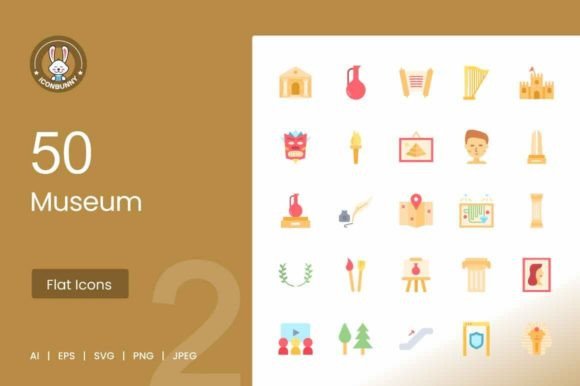
The utility of these icons extends far beyond traditional museum websites. Consider the education sector. Teachers creating interactive presentations about ancient history can use the "Scroll of Paper," "Harp," and "Egyptian God" icons to create engaging slideshows that hold student attention. The visual cues help break up text-heavy content and reinforce learning through association.
In the travel and tourism industry, apps focused on city guides can leverage icons like "Castle with Flag," "Monument Display," and "Folded Map" to help tourists navigate cultural districts. These symbols act as universal signposts, transcending language barriers. A traveler might not read the local language, but a "Video Screening" icon clearly indicates where to find multimedia exhibits, while a "Museum Tag" suggests pricing or catalog information.
Even in corporate settings, these icons find their place. A company organizing a high-profile event might use the "Leaves Wreath" or "Crown Exhibit" icons for invitation designs or presentation templates to evoke a sense of prestige and history. The "Jet Exhibit" and "Tank Exhibit" icons could serve specialized purposes in military history forums or aviation enthusiast communities, providing specific visual markers that generic icons cannot match.
A Deep Dive into the Collection's Diversity
What truly sets the 50 Museum Flat Round Icons apart is the breadth of subjects covered. It is rare to find a single pack that encompasses everything from fine art to industrial history. The collection includes classic artistic elements like "Brushes," "Painting of Canvass," and "Ink and Pen," which are essential for galleries and creative studios. Simultaneously, it addresses archaeological interests with items like "Antique Jar," "Bones Exhibit," and "Tools Exhibit."
The inclusion of architectural and infrastructural elements is equally vital. Icons such as "Escalator," "Pillar," "Column," and "Trees" allow designers to map out physical spaces digitally. This is particularly useful for wayfinding systems within large museum complexes. Imagine a digital map where a user can tap on a "Human Sculpture" icon to get directions to a specific exhibit hall, or locate the nearest "Art Museum Guide" station.
Furthermore, the collection acknowledges the modern operational side of museums. Icons like "Security Check," "Walkie Talkie," and "CCTV Camera" reflect the reality of managing large public institutions. These aren't just decorative; they represent safety protocols and staff communication tools. Including them in a design toolkit allows for the creation of comprehensive internal dashboards or public-facing safety information pages that are both clear and authoritative.
Enhancing User Experience Through Specificity
Specificity drives engagement. Generic icons often fail to communicate the unique nature of a brand or a specific exhibit. By offering distinct representations like "Egyptian Face," "Greek God," and "Diamond Exhibit," this collection allows creators to tailor their visuals to the exact context. If a museum is hosting a special exhibition on Roman history, the "Roman Column" or "Broken Pillar" icons can be highlighted to create a thematic visual identity.
This level of detail also aids in storytelling. A sequence of icons can tell a narrative journey. A user might start with a "Museum Building I," proceed to "Tickets," pass through a "Security Check," view a "Painting Exhibit," and finally see a "Video Screening." This linear progression helps guide the user through a logical flow, enhancing the overall narrative experience of the digital product.
Future-Proofing Your Creative Assets
As technology continues to evolve, the demand for flexible, high-quality visual assets will only increase. The rise of augmented reality (AR) and virtual reality (VR) in museums means that 2D icons are increasingly being used as anchors for 3D experiences. Because these icons are vector-based and easy to edit, they can be adapted for these emerging technologies with relative ease. The "Easy to edit and scale" feature mentioned in the specifications is not just a convenience; it is a future-proofing strategy.
Moreover, the shift toward sustainable digital practices favors vector graphics. They are smaller in file size compared to high-resolution raster images, leading to faster load times and reduced data consumption. This is critical for mobile users who may be browsing on limited data plans. The 50 Museum Flat Round Icons support this efficiency, ensuring that your digital presence remains fast and responsive.
For freelancers and small business owners, investing in a comprehensive icon set like this eliminates the need to commission individual illustrations for every project. It streamlines the workflow, allowing teams to focus on strategy and content rather than getting bogged down in asset creation. The ability to mix and match icons from the "Jewel Exhibit" to the "Ancient Chair" provides endless combinations for branding, marketing materials, and interface design.
Conclusion: A Strategic Investment in Visual Communication
The 50 Museum Flat Round Icons collection is more than a library of images; it is a toolkit for effective communication in a visual-first world. By combining historical richness with modern design principles, it empowers creators to build interfaces that are both beautiful and functional. Whether you are an educator bringing history to life, a developer building the next great museum app, or a marketer crafting a compelling brand story, these icons offer the precision and flexibility needed to succeed.
In an era where users judge credibility within seconds, the quality of your visual assets matters. These icons ensure that your message is clear, your brand is consistent, and your audience is engaged. As the digital landscape continues to shift, having a reliable, versatile, and professionally designed set of icons will remain a cornerstone of successful creative practice. Embrace the evolution of design, and let these visual tools guide your next project toward excellence.